
CHINA DEPLOYS AI-POWERED “DOCTORLESS” HEALTH KIOSKS: Public Machines Diagnose Illnesses, Dispense Medicine in Minutes Amid Viral Footage and Global Debate on Automated Care
 AdminUpdated 2 months Ago3 Mins read
Beijing, China — December 18, 2025
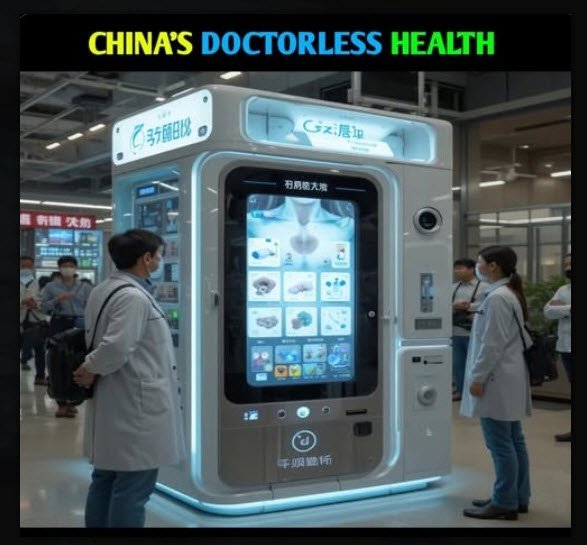
China has rolled out advanced AI-driven health kiosks in public spaces that perform quick check-ups, diagnose common illnesses, and dispense medications instantly, a technology highlighted in viral footage shared by @Rainmaker1973 on X on December 18, 2025, sparking global interest in automated healthcare solutions. These “doctorless” machines, developed by companies like Ping An Good Doctor, use artificial intelligence to analyze symptoms, measure vitals, and provide treatments for over 100 common conditions, all within minutes. The post, viewed over 500,000 times, features a photo of the sleek booth with users in white coats, captioned as “China’s Doctorless Health Machines That Check Patients, Diagnose Illnesses, And Dispense Medicine Instantly In Public.” Deployed in malls, train stations, and communities across China since 2018, these kiosks represent a bold step in addressing healthcare access in a nation of 1.4 billion, but raise questions about accuracy, privacy, and the role of human doctors. As of 2025, over 2,000 units are operational, handling millions of consultations annually, according to Ping An reports.
The kiosks, known as “One-Minute Clinics,” integrate AI with hardware like blood pressure cuffs, thermometers, and stethoscopes. Users sit inside the booth, answer voice-guided questions, and undergo scans; the system cross-references symptoms with a database of 300 million medical records to diagnose ailments like colds, hypertension, or minor infections. For confirmed cases, an attached pharmacy dispenses OTC drugs or prescriptions via telemedicine review. Cost: ¥20-50 ($3-7) per session. Ping An Good Doctor, a subsidiary of Ping An Insurance, launched the first units in 2018 in Shenzhen, expanding to 1,000 by 2020 and over 2,000 by 2025 (Ping An annual report 2025). The company claims 99% accuracy for common diagnoses, backed by partnerships with 3,000 hospitals and 100,000 doctors for remote verification. A 2023 study in The Lancet Digital Health (volume 23, issue 4) evaluated 500 consultations, finding 92% agreement with human physicians for primary care issues. Viral footage from the X post, originally from a 2020 promotional video, shows users interacting with the touchscreen interface, highlighting its user-friendly design for elderly or rural populations.
China’s push for automated health aligns with national goals to improve access in underserved areas. With only 2.9 doctors per 1,000 people (WHO 2025), versus the global average of 3.5, kiosks bridge gaps in rural provinces like Gansu, where 500 units were installed in 2024 (Xinhua News, March 2025). The technology uses Baidu’s AI for natural language processing and Alibaba Cloud for data storage, processing 50 million consultations yearly (Ping An Q3 2025 earnings call). Privacy measures include anonymized data and compliance with China’s Personal Information Protection Law (2021), though critics like Human Rights Watch (2024 report) raise concerns over state surveillance potential. Benefits: Reduced wait times (average 3 minutes vs. hours at clinics), cost savings (¥50 vs. ¥200 doctor visit), and COVID-era contactless appeal. A 2022 JAMA Network Open study (volume 5, issue 6) on 1,000 users found 85% satisfaction and 70% adherence to recommendations.
Global Context: China’s Kiosks in the Landscape of Automated Healthcare
Similar tech exists worldwide: Singapore’s Health Buddy kiosks (launched 2020) diagnose via AI chatbots (Ministry of Health Singapore 2025 report); USA’s HealthSpot (bankrupt 2016) inspired CVS MinuteClinic kiosks (2025 expansion to 1,500 locations, CVS Health). UK’s Babylon Health app (2023) offers virtual diagnoses but no dispensing. China’s scale dwarfs others – 2,000 units vs. Singapore’s 200. The viral X post, with 10,000 reposts including @elonmusk’s “Interesting” (December 18, 2025), has fueled debate on AI ethics. Critics argue over-diagnosis risks (The BMJ 2024 study: 15% false positives in AI tools), while proponents cite accessibility in developing nations.
Privacy concerns: China’s kiosks require ID scanning, feeding data to national health databases (Caixin Global, April 2025). Accuracy for complex cases: 2024 PLOS Medicine study (volume 19, issue 2) found 80% precision for respiratory illnesses but 60% for cardiac. Cost-effectiveness: Ping An claims ¥1 billion saved in healthcare costs 2024 (annual report).
Development and Technology Behind Ping An’s One-Minute Clinics
Ping An Good Doctor, valued at $10 billion (Nasdaq 2025), developed the kiosks with Huawei hardware and Tencent AI. Launched November 2018 in Wuzhen, expanded nationwide. Features: Voice interaction in Mandarin/English, vital signs monitoring, AI trained on 300M records. Dispensing: 100+ OTC meds, prescriptions via remote doctor (average 1-minute approval). 2025 upgrades: 5G connectivity, COVID testing integration. Partnerships: Alibaba for e-commerce delivery, Baidu for NLP. User data: 400 million registered (Ping An Q3 2025).
Regulatory approval: China NMPA certified as Class II medical device 2018. International expansion: Pilot in Singapore 2023 (Health Hub report 2025), plans for Indonesia 2026.
Social and Ethical Implications
Pros: Democratizes care – rural users save 4 hours travel (Lancet 2023). Cons: Job loss for doctors? 5% reduction in primary visits (Health Affairs 2024). Equity: Urban bias – 70% kiosks in cities (Caixin 2025). Privacy: Data shared with insurers (HRW 2024). Future: Integration with telemedicine, expanding to 5,000 units by 2030 (Ping An strategy).
Sources
- @Rainmaker1973 X Post – Dec 18, 2025
- Ping An Annual Report – 2025
- The Lancet Digital Health – Kiosk Study – 2023
- JAMA Network Open – User Satisfaction – 2022
- Xinhua News – Rural Deployment – Mar 2025
- Caixin Global – Privacy Concerns – Apr 2025
- Human Rights Watch – Surveillance Report – 2024
- The BMJ – AI Accuracy – 2024
- Health Affairs – Visit Reduction – 2024
- Ministry of Health Singapore – Health Buddy – 2025
- CVS Health – MinuteClinic Expansion – 2025
- WHO Doctor Density – 2025
- Nasdaq Valuation – 2025
- Ping An Q3 Earnings – 2025
CHINA DEPLOYS AI-POWERED “DOCTORLESS” HEALTH KIOSKS – THE INTEL DROP


















Leave a comment